
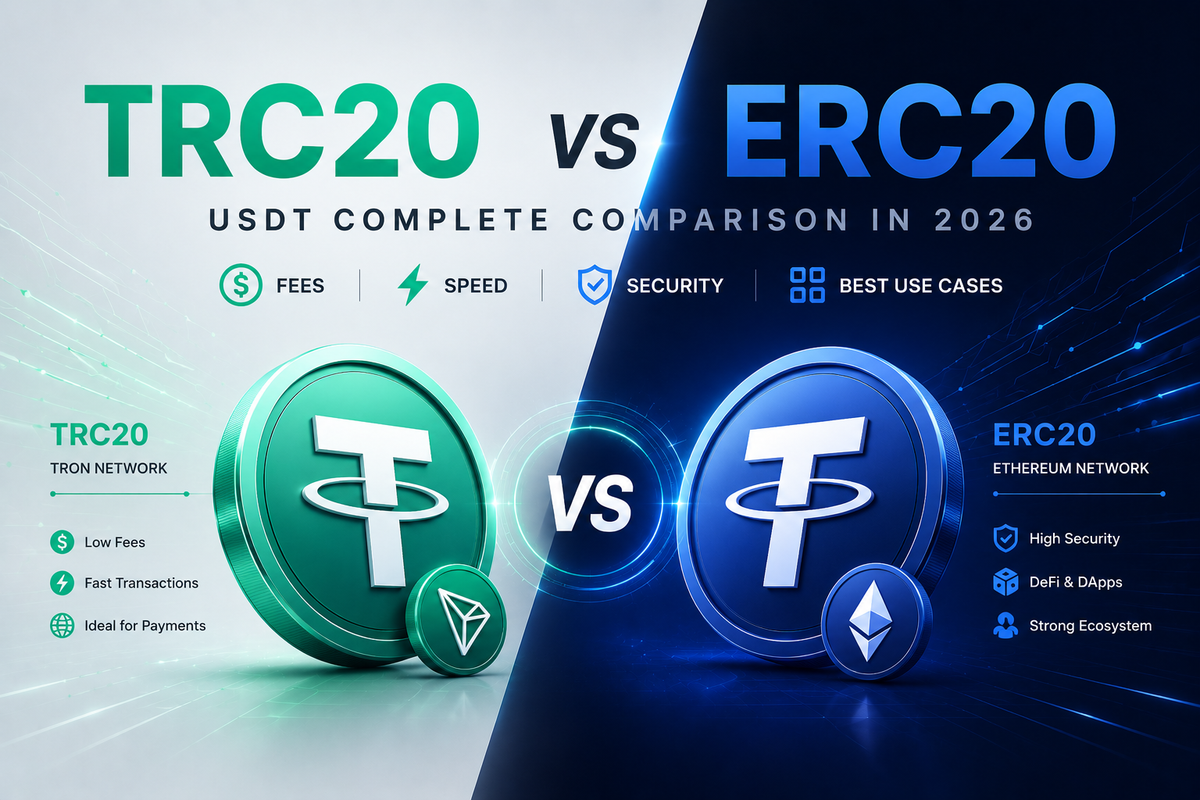
TRC20 vs ERC20: Complete USDT Fee, Speed, and Security Comparison in 2026

Keywords: TRC20 vs ERC20, USDT Transfer Fees, Best USDT Network, Cheapest Way to Send USDT, TRC20 USDT, ERC20 USDT, USDT Deposit Guide
Introduction
USDT is the most widely used stablecoin in the world.
Millions of users rely on USDT for:
- International payments
- Cross-border transfers
- Crypto trading
- Business settlements
- Digital asset management
However, one of the most common mistakes users make is choosing the wrong network when sending USDT.
Many people assume all USDT is the same.
In reality, USDT exists on multiple blockchain networks, including:
- TRC20 (TRON)
- ERC20 (Ethereum)
- BEP20 (BNB Chain)
Choosing the wrong network can result in:
- Higher fees
- Slower transactions
- Failed transfers
- Permanent loss of funds
In this guide, we'll compare TRC20 and ERC20 in terms of fees, speed, security, and real-world use cases to help you choose the best USDT network in 2026.
What Is TRC20 USDT?
TRC20 USDT is USDT issued on the TRON blockchain.
TRON was designed to support:
- Fast transactions
- Low fees
- High throughput
Today, TRC20 has become one of the most popular networks for transferring USDT internationally.
It is widely used by freelancers, businesses, exchanges, and payment platforms because of its speed and cost efficiency.
What Is ERC20 USDT?
ERC20 USDT is USDT issued on the Ethereum blockchain.
Ethereum is the world's largest smart contract ecosystem.
ERC20 USDT is commonly used for:
- DeFi applications
- Smart contracts
- Decentralized applications (DApps)
- Institutional crypto services
Many crypto exchanges and blockchain protocols support ERC20 by default, making it one of the most established USDT networks.
TRC20 vs ERC20: Quick Comparison
| Feature | TRC20 | ERC20 |
|---|---|---|
| Blockchain | TRON | Ethereum |
| Average Fee | Low | Higher |
| Speed | Fast | Moderate |
| DeFi Integration | Limited | Extensive |
| Smart Contract Ecosystem | Basic | Advanced |
| Exchange Support | Very High | Very High |
| Business Payments | Excellent | Good |
| Everyday Transfers | Excellent | Moderate |
Transfer Fee Comparison
One of the biggest reasons users choose TRC20 is cost.
TRC20 Fees
TRC20 is known for:
- Low network fees
- Cost-efficient transfers
- Frequent use for international payments
Many users select TRC20 when sending USDT between exchanges or payment platforms because transfer costs are typically minimal.
ERC20 Fees
ERC20 fees depend on Ethereum network activity.
During periods of congestion:
- Transaction fees may increase significantly
- Small transfers become less economical
This makes ERC20 less attractive for frequent payment transfers and everyday transactions.
Speed Comparison
TRC20 Speed
Typical confirmation time:
1–3 minutes
Advantages include:
- Fast confirmations
- Efficient transfers
- Suitable for business payments
- Reliable international transactions
ERC20 Speed
Typical confirmation time:
Several minutes depending on network conditions
Advantages include:
- Strong network security
- Deep ecosystem integration
- Extensive application support
Limitations include:
- Network congestion can affect transaction speed
- Gas fees may rise during peak activity
Security Comparison
TRON Security
TRON provides a stable blockchain environment and processes large volumes of USDT transactions every day.
Benefits include:
- Reliable network operations
- High transaction capacity
- Proven payment infrastructure
Ethereum Security
Ethereum is widely regarded as one of the most secure blockchain ecosystems in the world.
Benefits include:
- Large validator network
- Extensive developer ecosystem
- High institutional adoption
- Mature smart contract infrastructure
For users prioritizing DeFi and smart contract applications, Ethereum remains a leading choice.
Which Network Is Better for International Payments?
For payment-focused users, the answer is often straightforward.
TRC20 Is Better For:
- Sending USDT internationally
- Receiving payments
- Business settlements
- Freelancer payments
- Everyday transfers
Why?
Because it offers:
- Lower fees
- Faster transactions
- Greater cost efficiency
- Better suitability for frequent payments
ERC20 Is Better For:
- DeFi participation
- Ethereum-based applications
- Smart contract interactions
- Institutional crypto workflows
Why?
Because Ethereum has the world's largest decentralized application ecosystem.
Common Mistakes When Sending USDT
Sending to the Wrong Network
This is one of the most common mistakes.
Example:
Sending TRC20 USDT to an ERC20 address.
This can result in permanently lost funds.
Always verify:
- Network type
- Wallet compatibility
- Deposit instructions
before transferring any assets.
Ignoring Network Requirements
Some platforms only support specific USDT networks.
Always check the supported network before sending funds.
Choosing ERC20 for Small Transfers
Many beginners unknowingly choose ERC20 for small payments and end up paying unnecessary fees.
For simple transfers and international payments, TRC20 is often more economical.
Real-World Examples
Freelancer Receiving International Payments
A freelancer receives USDT from an international client.
Goals:
- Fast access to funds
- Minimal transfer costs
TRC20 is often the preferred option.
Remote Worker Receiving Monthly Income
Monthly salary arrives in USDT.
Requirements:
- Reliability
- Low fees
- Fast settlement
TRC20 typically offers a cost-efficient solution.
DeFi Investor
An investor plans to:
- Lend assets
- Participate in liquidity pools
- Use decentralized applications
ERC20 may be the better choice because of Ethereum's extensive ecosystem.
International Business Settlement
A company needs to settle payments globally.
Requirements:
- Speed
- Cost efficiency
- Scalability
TRC20 is frequently used for this purpose.
How HOYAPAY Supports USDT Transfers
HOYAPAY helps users manage global payments and digital assets through a unified platform.
Users can:
Receive USD Payments
Collect international payments through USD Accounts.
Manage Stablecoins
Hold and transfer USDT efficiently.
Access Multi-Currency Support
Convert funds when necessary.
Use Virtual Cards
Spend globally on:
- ChatGPT
- Netflix
- AWS
- Google Ads
- Meta Ads
Transfer Funds Internationally
Move assets across borders more efficiently.
This flexibility helps freelancers, creators, digital nomads, remote workers, and global businesses manage both traditional finance and digital assets from a single platform.
Frequently Asked Questions
What is TRC20 USDT?
TRC20 USDT is USDT issued on the TRON blockchain.
What is ERC20 USDT?
ERC20 USDT is USDT issued on the Ethereum blockchain.
Which network has lower fees?
TRC20 generally has lower transaction costs.
Which network is faster?
TRC20 is often faster for everyday transfers and payment transactions.
Which network is safer?
Both networks are widely used and secure when used properly.
Which network is best for freelancers?
Many freelancers prefer TRC20 because of its lower fees and faster settlement.
Which network is best for DeFi?
ERC20 remains the dominant network for decentralized finance applications.
Can I send TRC20 USDT to an ERC20 address?
No.
Always match the sending and receiving networks.
What is the cheapest way to send USDT?
TRC20 is often considered one of the most cost-efficient USDT transfer networks available.
Final Verdict
Both TRC20 and ERC20 play important roles in the USDT ecosystem.
Choose TRC20 if your goal is:
- International payments
- Freelancer income
- Business settlements
- Lower transfer costs
- Faster transfers
Choose ERC20 if your goal is:
- DeFi participation
- Smart contract usage
- Ethereum ecosystem access
For most users sending or receiving USDT in 2026, TRC20 remains one of the most practical choices because of its excellent balance of speed, cost efficiency, and global accessibility.
Ultimately, the best network depends on how you use USDT and the types of applications you need to support.