USDT vs Bank Transfer: Which Is Better for International Payments in 2026?

Keywords: USDT Payments, Stablecoin Payments, USDT vs Bank Transfer, Cross Border Payments, International Money Transfer, Global Payments, Send Money Internationally
Introduction
Sending money internationally has never been more important.
Freelancers receive payments from overseas clients. Businesses pay international suppliers. Remote workers earn salaries from companies located in different countries.
For decades, international bank transfers have been the standard method for moving money globally.
However, the rise of stablecoins such as USDT is changing how people think about cross-border payments.
Today, many businesses and individuals are asking:
Should I use a traditional bank transfer or USDT?
In this guide, we'll compare USDT and bank transfers across speed, cost, accessibility, transparency, and practical use cases to help you determine which solution is best for international payments in 2026.
What Is a Bank Transfer?
A bank transfer is the movement of money between financial institutions.
For international payments, transfers typically move through:
- SWIFT Network
- Correspondent Banks
- Receiving Banks
This system has been the backbone of global finance for decades.
Common use cases include:
- Business payments
- Supplier settlements
- International payroll
- Personal remittances
What Is USDT?
USDT (Tether) is the world's largest stablecoin.
Unlike cryptocurrencies that fluctuate significantly in value, USDT is designed to maintain a value close to 1 US Dollar (USD).
This makes USDT attractive for:
- International transfers
- Cross-border payments
- Digital commerce
- Global settlements
USDT can be transferred through multiple blockchain networks, including:
- TRC20 (TRON)
- ERC20 (Ethereum)
- BEP20 (BNB Chain)
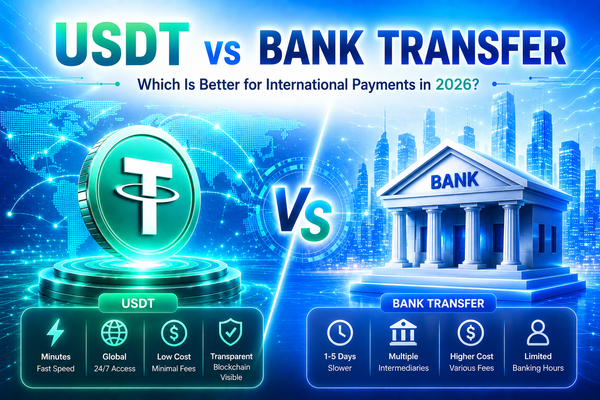
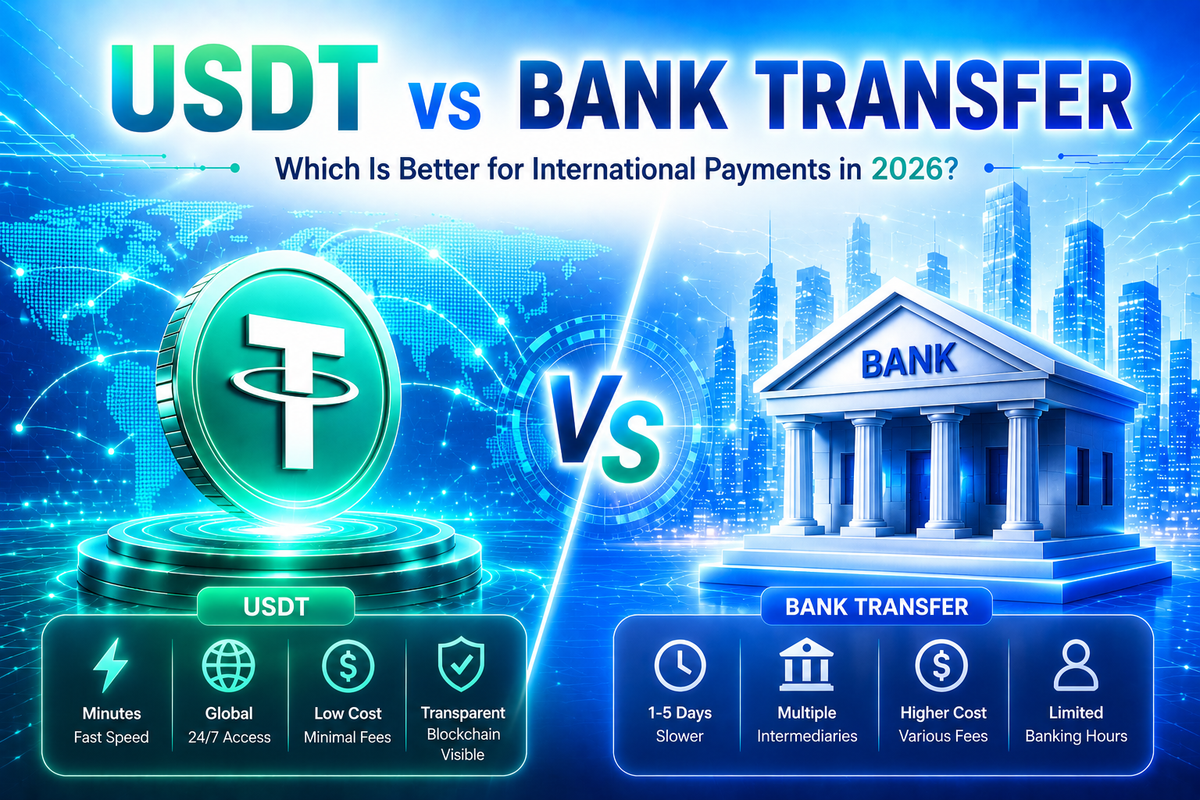
USDT vs Bank Transfer: Quick Comparison
| Feature | Bank Transfer | USDT |
|---|---|---|
| Settlement Speed | 1–5 Business Days | Minutes |
| International Access | Depends on Banks | Global |
| Operating Hours | Banking Hours | 24/7 |
| Intermediaries | Multiple | Minimal |
| Transparency | Limited | Blockchain Visible |
| Transfer Fees | Varies | Network Fees |
| Weekend Transfers | Limited | Yes |
| Cross-Border Payments | Yes | Yes |
Speed Comparison
Bank Transfer
International transfers often require:
Sending Bank
↓
Correspondent Bank
↓
Receiving Bank
Each institution adds processing time.
Typical Processing Times
- Domestic Transfers: Same Day to 1 Business Day
- International Transfers: 1–5 Business Days
Payments may take longer due to:
- Compliance reviews
- Banking holidays
- Time zone differences
USDT
USDT transactions occur on blockchain networks.
TRC20
Typical confirmation time:
1–3 minutes
BEP20
Typical confirmation time:
1–5 minutes
ERC20
Confirmation times depend on network congestion.
In most situations, funds arrive significantly faster than traditional international transfers.
Cost Comparison
Bank Transfer Costs
International bank transfers may involve:
Sending Fees
Charged by the originating bank.
Receiving Fees
Charged by the receiving bank.
Intermediary Fees
Deducted by correspondent banks.
FX Conversion Fees
Applied when currencies are exchanged.
These costs can accumulate quickly for businesses and individuals making frequent international payments.
USDT Costs
USDT transfers generally involve blockchain network fees.
Examples include:
TRC20
Often among the lowest-cost options.
BEP20
Typically low-cost.
ERC20
Can become expensive during periods of network congestion.
Because there are fewer intermediaries involved, overall costs are often lower than traditional international bank transfers.
Availability Comparison
Bank Transfers
Bank transfers require:
- Bank accounts
- Banking infrastructure
- Banking hours
Access may vary by country.
Some regions face:
- Limited banking access
- Slower international payment systems
USDT
USDT is available globally wherever supported platforms and wallets exist.
Advantages include:
- 24/7 access
- Borderless transfers
- No dependence on banking hours
This is particularly useful for freelancers, digital nomads, and international businesses operating across different time zones.
Transparency Comparison
Bank Transfers
Tracking international payments can sometimes be difficult.
Users may not always know:
- Where the payment currently is
- Which intermediary bank is involved
- Why delays occur
USDT
Blockchain transactions are publicly verifiable.
Users can:
- Track transaction status
- Verify confirmations
- Monitor transfer progress
This creates a significantly higher level of transparency.
Security Comparison
Bank Transfers
Banking systems are heavily regulated and have long-established security frameworks.
Advantages
- Regulatory oversight
- Consumer protection mechanisms
- Mature financial infrastructure
USDT
Blockchain systems rely on cryptographic security.
Advantages
- Immutable transaction records
- Transparent settlement processes
Users should still follow best practices, including:
- Two-factor authentication (2FA)
- Secure wallets
- Phishing protection
When Bank Transfers Make Sense
Bank transfers may be preferable when:
Large Corporate Transactions
Some organizations require traditional banking infrastructure.
Regulated Financial Workflows
Certain industries depend heavily on banking systems and regulatory compliance.
Traditional Business Relationships
Many companies still prefer bank-based payments and accounting processes.
When USDT Makes Sense
USDT may be preferable when:
Speed Matters
Funds can often arrive within minutes.
Global Accessibility Matters
There is no dependency on banking schedules.
Lower Transfer Costs Matter
Especially for frequent international payments.
24/7 Availability Matters
Transfers can occur anytime, including weekends and holidays.
Real-World Use Cases
Freelancer Receiving International Payments
A freelance developer in Vietnam receives payments from a client in the United States.
Using USDT may allow faster access to funds compared with traditional international banking channels.
E-commerce Business
An online seller receives payments globally and needs to move funds quickly between regions.
Stablecoins can simplify international settlement and improve cash flow management.
International Supplier Payments
Businesses paying overseas suppliers often seek:
- Faster settlement
- Lower costs
- Better transparency
USDT can provide additional flexibility.
Digital Nomad
A digital nomad working across multiple countries benefits from borderless payment infrastructure and around-the-clock access to funds.
How HOYAPAY Supports Both Fiat and Stablecoin Payments
HOYAPAY bridges traditional finance and digital assets through a single platform.
Users can:
Receive USD Payments
Collect international payments through USD Accounts.
Manage Multiple Currencies
Hold and exchange funds efficiently.
Transfer Funds Globally
Move money internationally with greater flexibility.
Access Virtual Cards
Pay for subscriptions and online services.
Use Stablecoins
Manage USDT alongside traditional financial tools.
This flexibility helps freelancers, creators, digital nomads, remote workers, and global businesses operate more efficiently.
Frequently Asked Questions
Is USDT faster than a bank transfer?
In many situations, yes.
USDT transactions can settle within minutes depending on the blockchain network.
Is USDT cheaper than international bank transfers?
Costs vary, but USDT often involves fewer intermediaries and lower overall transfer costs.
Can businesses use USDT for international payments?
Yes.
Many businesses use stablecoins for cross-border transactions and global settlements.
Is USDT available 24/7?
Yes.
Blockchain networks operate continuously.
Which USDT network is best?
TRC20 is often chosen for its lower fees and fast transaction confirmations.
Can freelancers receive payments in USDT?
Yes.
Many freelancers use USDT for international payments because of its speed and flexibility.
Can I convert USDT into fiat currency?
Yes.
Many global payment platforms support conversion between stablecoins and fiat currencies.
Is USDT replacing bank transfers?
Not entirely.
Both systems serve different use cases and often complement each other.
Final Verdict
Bank transfers remain a foundational part of global finance.
They continue to play an important role in corporate payments, regulated industries, and traditional banking relationships.
However, stablecoins such as USDT are reshaping international payments by offering:
- Faster settlement
- Global accessibility
- 24/7 operation
- Reduced reliance on intermediaries
- Improved transparency
For freelancers, digital nomads, remote workers, global businesses, and international entrepreneurs, USDT has become an increasingly attractive option for cross-border payments in 2026.
Ultimately, the best choice depends on your payment needs, preferred financial infrastructure, and operational requirements.